
Voltage-gated potassium channels (Kv) are the largest and most diverse class of ion channels. These proteins are present in excitable and non-excitable cells. Their main functions are related to regulating the resting membrane potential and controlling the shape and frequency of action potentials. Potassium voltage-gated channel subfamily S member 2 is a protein encoded by the KCNS2 gene in humans. The protein encoded by this gene is a voltage-gated potassium channel alpha subunit, which is involved in the formation of the Kv2 ion channel.
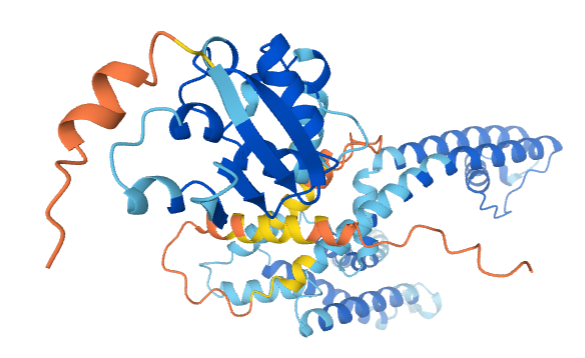
Figure 1. Protein structure of KCNS2.
The study found that there are two types of potassium channel alpha subunits: one that is functional on its own, and the other that is electrically silent, but able to modulate the activity of specific functional alpha subunits. The protein encoded by this gene is not functional on its own, but can form heteromultimers with members 1 and 2 (and possibly others) of the shab-related subfamily of potassium voltage-gated channel proteins. The potassium channel alpha subunit encoded by KCNS2 belongs to the latter.
Cloning and Expression of KCNS2
By searching the Expressed Sequence Tag (EST) database for the silenced Kv8.1 alpha subunit (KCNV1), the researchers discovered a human cDNA encoding KCNS2, which they dubbed Kv9.2. Using these ESTs, the scientists isolated mouse KCNS2 cDNA from a brain cDNA library. Further investigation revealed that the predicted KCNS2-encoded protein possesses all the structural features of the outwardly rectifying Kv α subunit, namely 6 transmembrane domains (S1 - S6), 5 positively charged amino acid transmembrane regions and a conserved Pore-forming region (designated H5 or P domain). Several putative phosphorylation sites are located in the cytoplasmic region.
Structure of the Kv9.2
Previous studies have shown that Kv9.1 and Kv9.2 encode 497 amino acids and 477 amino acids of proteins, respectively, with molecular masses of 54.9 and 54.3 kDa. The Kv9.1 and Kv9.2 subunits contain several putative phosphorylation sites located in the cytoplasmic regions of protein kinase C, camp-dependent protein kinase, Ca2+-calmodulin kinase II, casein kinase II and tyrosine kinase.
Expression of Kv9.2
Through specific probe detection, the researchers found that the transcript sizes of two Kv9.1 were estimated to be 2.2 and 2.7 kb, and the transcript size of one Kv9.2 was estimated to be 5.3 kb. Further in situ hybridization revealed that high levels of KCNS2 mRNA were detected in the olfactory bulb, cerebral cortex, hippocampal structure, habenula, basolateral amygdala, and cerebellum; in addition, Kv9.2 expression was also found in the retina and spinal cord. The expression of Kv9.2 was not found in the heart, spleen, lung, liver, skeletal muscle, kidney and testis. Therefore, it is indicated that KCNS2 is only expressed in the brain.
Function of Kv9.2
Functional functions of K+ channels include processes such as neural integration, pacemaker production, muscle contraction, and hormone secretion in excitatory cells, as well as cell proliferation, cell volume regulation, and lymphocyte differentiation. The study found that Kcns2 itself does not have potassium channel activity, but participates in in vivo activities by regulating the α subunit of Kv2 ion channel. That is, the activation kinetics and voltage dependence of Kv2.1 current was altered by this expression with Kv9.2. Therefore, the function of Kv9.2 is consistent with the Kv2 ion channel it controls.
References
- Salinas M et al. New modulatory alpha subunits for mammalian Shab K+ channels. J. Biol. Chem., 1997, 272 (24371-9).
- Gutman GA et al. International Union of Pharmacology. LIII. Nomenclature and molecular relationships of voltage-gated potassium channels. Pharmacol. Rev., 2005, 57 (473-508).
- Richardson FC et al. Modification of delayed rectifier potassium currents by the Kv9.1 potassium channel subunit. Hear. Res., 2000, 147 (21-30).
- Banfi, S., et al.; Identification and mapping of human cDNAs homologous to Drosophila mutant genes through EST database searching. Nature Genet. 1996, 13: 167-174.
Inquiry